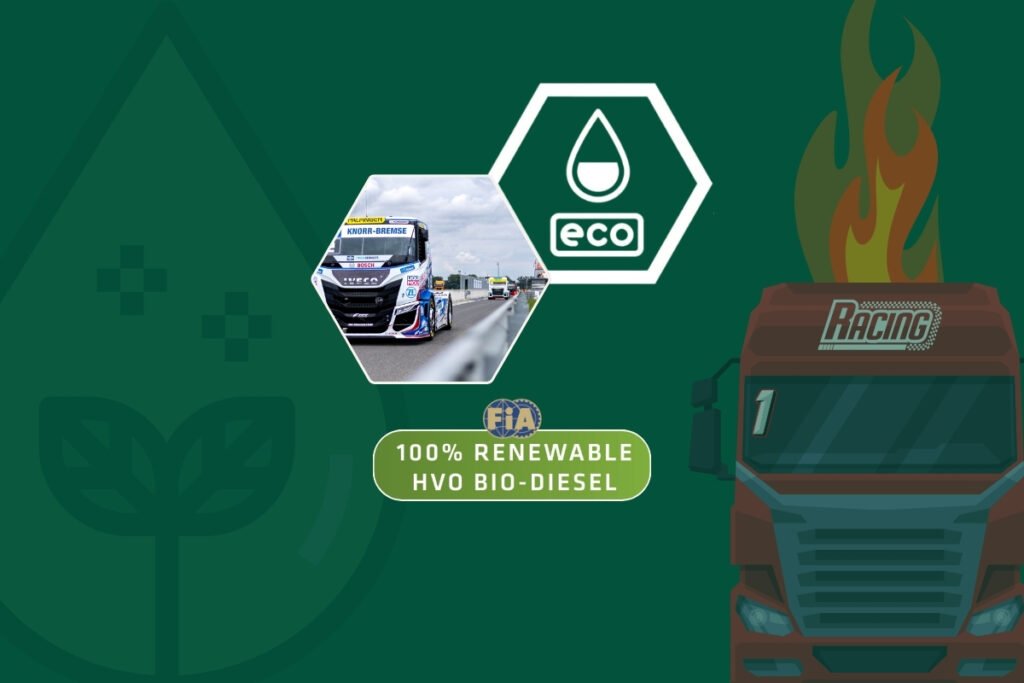
Who set the stage for the advanced sustainable fuel (AS Fuel) in motorsport? Was it the World Endurance Championship with its legendary 24-hours of Le Mans? If not, perhaps Formula 1 simply leveraged its financial resources and workforce? Not at all! In search for an answer, let’s turn toward one of the most unconventional racing series in the world – ETRC.
- ETRC stands for the European Truck Racing Championship.
- ETRC switched to sustainable fuel back in 2021, first FIA-sanctioned series to do so.
- This fuel reaches at least 65% greenhouse gas emissions savings.
- Future regulations will see ramp-up of multiple sustainable technologies in ETRC.
ETRC – European Truck Racing Championship – is, as the name suggests, series made exclusively for trucks. Without the splendor of rally or endurance racing, it has never attracted a tremendous amount of fanbase. Yet, there is something that all the faithful enthusiasts of the ETRC experienced prior to the big fishes of the motorsport world.
Back in 2021, ETRC became the first FIA-sanctioned series to switch to fully sustainable fuel. To be precise, trucks started to be powered by HVO – Hydrotreated Vegetable Oil.
HVO – Sustainable Fuel of the ETRC
Here is how FIA defines HVO.
HVO is a premium fossil-free diesel product made of 100% renewable raw materials, which does not release any new carbon dioxide into the atmosphere. It is produced by hydrotreatment of vegetable oils and animal fats, and the result is a premium quality fuel with a chemical structure nearly identical to regular diesel and that can be used in a regular combustion engine without the need for any modifications.
This fuel is not only produced from a fully renewable supply, but also reaches greenhouse gas emissions savings of at least 65% over the entire life cycle i.e. from well to wheel. Therefore, it complies with the requirements set by the latest EU RED (Renewable Energy Directive). HVO also meets the FIA criteria for the advanced sustainable fuel (AS Fuel).
New era on the horizon
Although TotalEnergies has been supplying HVO nonstop since 2021, ETRC looks beyond that one particular solution.
Last year new partnership with IVECO saw the introduction of electric S-eWay as the official pace truck of the series. Its predecessor run on bio-LNG.
News that broke out earlier this year suggests that there is even more to come.
According to the FIA, new ETRC regulations will be introduced in 2028. This ruleset is set to be compatible with electric, hybrid and hydrogen powertrains.
ETRC – perfect testing ground for sustainable tech
Undoubtedly, ETRC has been punching above its weight in terms of integrating sustainable technologies into its operations.
At first, it might be surprising. After all, the truck racing series got the better of Formula 1, WEC, and many more. However, when you think about it, it makes a lot of sense.
In the social media era, every failure is immediately exposed. And the bigger the audience, the higher the level of scrutiny. In other words, safety net gets smaller with popularity.
If Formula 1 encountered problems with sustainable fuels, the outrage would be huge. ETRC, on the other hand, would never have to deal with such consequences. Smaller outreach translates to significantly lower risk.
That is why ETRC is a perfect platform to test new solutions and pave the way for them to arrive on the grand scene.