
Sustainable fuel in motorsport context is a very general term. Not only there are different types of sustainable fuel, but also different grades. Depending on your needs and activity, you are likely to choose between bunch of them. How can you avoid confusion and mistakes?
In this article, you will gain straightforward insights together with practical examples, so later you turn newly-gained knowledge about sustainable fuel in motorsport into action.
Without any build-up or semi-related introduction – grade tells you how sustainable fuel really is. Every grade has a corresponding % number. It indicates degree to which given blend has been made from non-fossil components. Those components are often referred to as renewable, synthetic and/or bio. We will covert it in another article. Let us go back to different grades of sustainable fuel in motorsport.
What more else is to add, though? The grade you choose will have a direct impact on price, regulatory-compliance and emission savings. All of those factors can either help, or stand in a way of a your prosperous future. The goal is for you to perform on the track, have stable financial situation and improve negotiating position in talks with authorities and sponsors.
Price
The rule is – in the most cases – simple. The higher the grade, the higher the price. For 100% sustainable fuel, used for example in the European Rally Championship (ERC), cost still can be significantly higher even if is benchmarked against standard race fuel. However, there is also positive news in that context.
In the moment of writing, lower grades of sustainable fuel in motorsport are approaching price parity with the aforementioned race fuel. Yes, they can still be a little bit more expensive – just like 33% sustainable fuel used in the Porsche Carrera Cup Scandinavia. However, more often than not those few cents more per liter pay off.
Switching to sustainable fuel not only can improve the public image of your career, but if sponsorship follows, you will get invested money back with no time.
Regulatory-compliance with sustainable fuel in motorsport
Imagine you are participating in the round of the national rallycross championship. As a pilot test, everybody has access to one barrel of sustainable fuel. Initially, the organizer was reviewing multiple grades of sustainable fuel for the occasion. The ambition was to get as close to 100% AS Fuel as possible.
In spite of the clear goal, the fuel you ended up testing was 50% AS Fuel. The organizer had no choice but to settle for the lower grade as it was the only one that was complaint with all relevant regulations. It turned out that there is more to look out for than what’s in the championship rulebook.
I know – it sounds daunting and boring. Luckily for you, the aforementioned story happened in real life and I was involved in the entire process. Therefore, I know what it takes to find powerful yet entirely complaint sustainable fuel. Don’t miss your chance to put your career on a path towards prosperous future. Book entirely free consultation today.
Emission savings
As indicated at the start, grade is % of sustainable components in the blend. Hence, it will come to you as no surprise that higher grades – ergo the ones with no or little fossil components – are better for the environment. Let’s work it out on the examples below, in which selected grades of sustainable fuel has been compared to their fossil counterparts.
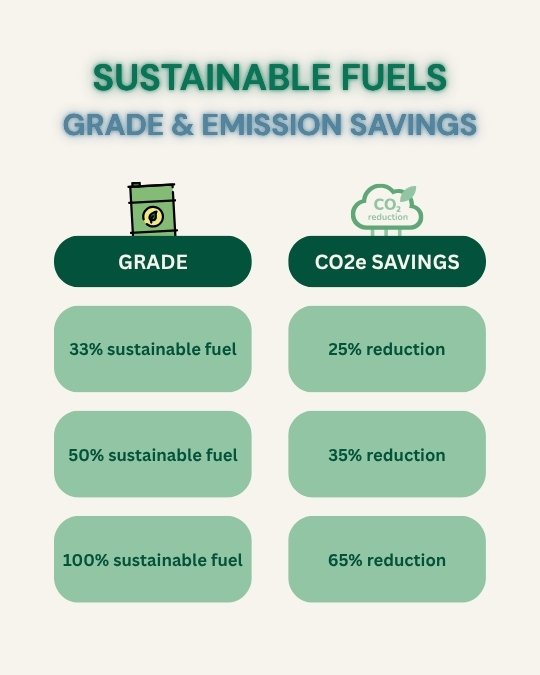
Emission savings must be in line with the latest EU RED (Renewable Energy Directive). For the 100% sustainable fuel, the CO2e reduction must be at least 65%. It means that there are cases it’s even more.
At times, topic of emission savings can be interconnected to regulatory-compliance. This is the bad news. The good is you no longer have to do it all by yourself. At Sustainable Paddock, you get support and guidance to make the most out of switching to sustainable fuel. Your finances, reputation and performance at the forefront of the transition.